


Yolandababe
New member
Last updated: April 17, 2026
Here is how the setup process works:
Storage options for physical gold include: [3]
Who this suits: Investors who want immediate, unrestricted access to their gold — whether for wealth preservation, emergency use, or simply the security of holding a tangible asset.
Gold IRA tax rules: [4]
Choose physical gold if: You want an asset outside the tax-advantaged system that you can access without retirement account restrictions.
Gold IRA typical costs:
Gold IRA liquidity:
Quick Answer
Gold IRAs and physical gold ownership both give U.S. investors exposure to precious metals, but they serve different goals. A Gold IRA fits best inside a retirement strategy, offering tax-deferred growth and IRS-regulated structure. Physical gold suits investors who want direct, personal control over a tangible asset outside the retirement system. The right choice depends on your timeline, tax situation, and how much flexibility you need.Key Takeaways
- Gold IRAs hold IRS-approved gold inside a self-directed retirement account, with the same tax treatment as a traditional or Roth IRA.
- Physical gold is gold you buy and store yourself, with no IRS restrictions on access but also no built-in tax advantages.
- Gold held in an IRA must be at least 99.5% pure and stored in an IRS-approved depository — you cannot keep it at home. [1]
- 401(k) to Gold IRA rollovers can typically be completed tax-free, preserving your retirement savings' tax-advantaged status. [4]
- Physical gold avoids ongoing management fees if stored personally, but insurance and third-party storage costs may apply. [3]
- Gold IRAs require Required Minimum Distributions (RMDs) starting at age 73, which can force liquidation at inconvenient times. [4]
- Physical gold is harder to liquidate quickly compared to ETFs or gold funds. [3]
- Gold reached new record highs in early 2026 before a significant reset in late January, with prices trading near approximately $5,000 per ounce as of April 2026. [4]
- Best for retirement savers: Gold IRA. Best for personal wealth protection: Physical gold.
What Is a Gold IRA and How Does It Work?
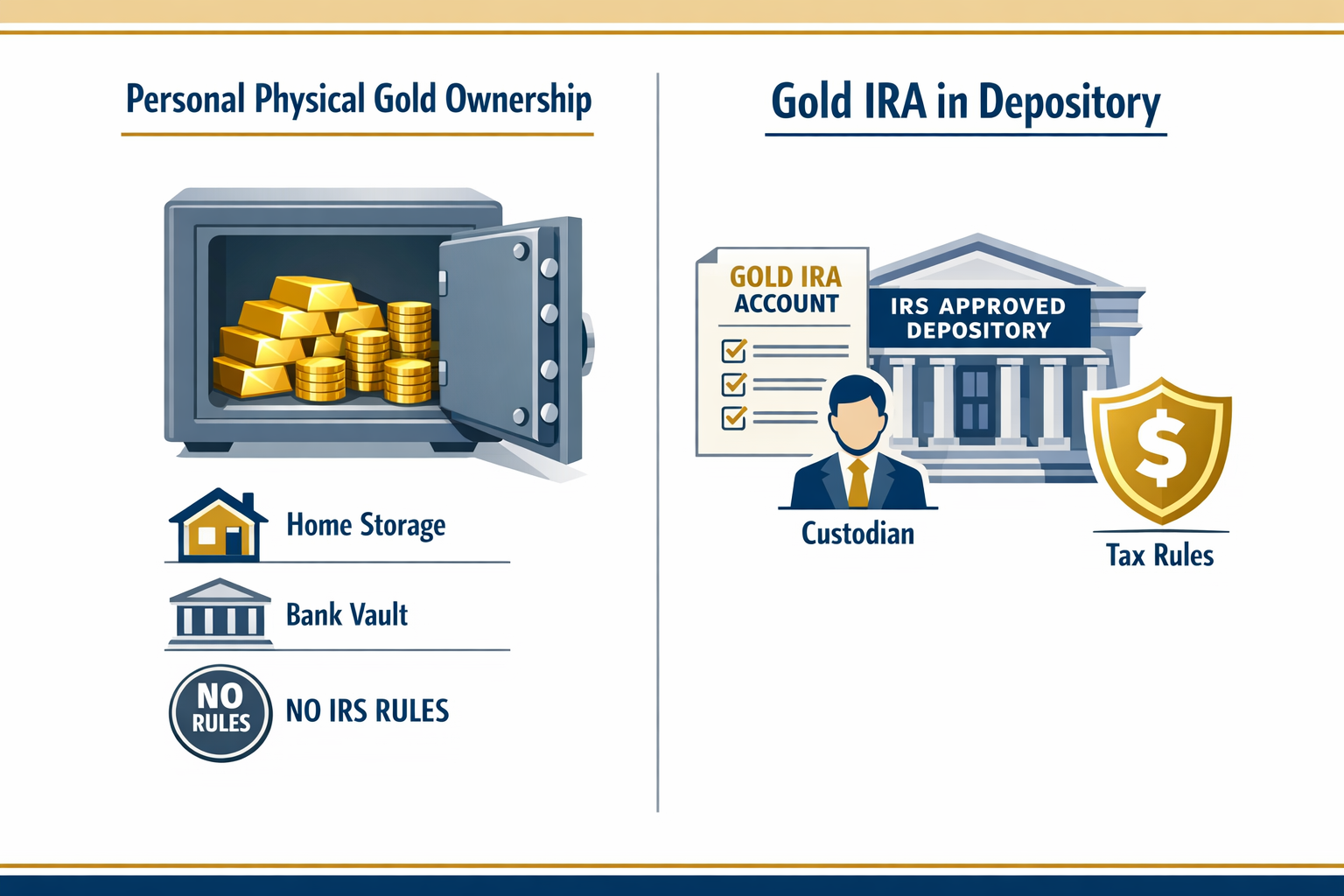
A Gold IRA is a self-directed Individual Retirement Account that holds physical precious metals instead of (or alongside) stocks and bonds. It follows the same IRS rules as a traditional or Roth IRA, including contribution limits, tax treatment, and distribution requirements.Here is how the setup process works:
- Open a self-directed IRA with a custodian that specializes in precious metals.
- Fund the account via a new contribution, a transfer from an existing IRA, or a rollover from a 401(k) or 403(b).
- Select IRS-approved metals — gold must meet a minimum purity of 99.5%. [1]
- The custodian purchases the metals on your behalf and arranges storage.
- Metals are stored in an IRS-approved depository. You cannot take personal possession while the account is active. [1][4]
What Does Owning Physical Gold Actually Mean?
Owning physical gold means purchasing gold coins or bars directly and taking personal possession. There is no IRS custodian involved, no account structure, and no contribution limits.Storage options for physical gold include: [3]
- A home safe or secure location
- A bank safety deposit box
- A third-party private storage company
Who this suits: Investors who want immediate, unrestricted access to their gold — whether for wealth preservation, emergency use, or simply the security of holding a tangible asset.
Gold IRA Vs Physical Gold: Key Differences at a Glance
The core differences come down to control, taxes, costs, and purpose. The table below summarizes the most important factors:| Factor | Gold IRA | Physical Gold |
|---|---|---|
| Tax treatment | Tax-deferred (traditional) or tax-free growth (Roth) | No ongoing tax advantage |
| Storage | IRS-approved depository only | Home, bank, or private storage |
| Purity requirement | 99.5% minimum (IRS rule) | No restriction |
| Access | Restricted until retirement age | Immediate, unrestricted |
| Setup required | Custodian + depository | None required |
| RMDs | Yes, starting at age 73 | No |
| Fees | Custodian, storage, setup fees | Optional insurance/storage |
| Liquidity | Moderate (must go through custodian) | Lower (physical sale required) |
| Rollover eligible | Yes (from 401k, IRA, etc.) | No |
Key insight: A Gold IRA is fundamentally a retirement account that happens to hold gold. Physical gold is a direct asset you own outright. These are different tools for different financial goals.
Before opening a Gold IRA, compare the top-rated companies here: Best Gold IRA Companies 2026
How Does the Tax Treatment Differ?
Tax treatment is one of the biggest practical differences between a Gold IRA and physical gold.Gold IRA tax rules: [4]
- Traditional Gold IRA: Contributions use pre-tax dollars. Growth is tax-deferred. You pay ordinary income tax when you take distributions.
- Roth Gold IRA: Contributions use after-tax dollars. Qualified distributions in retirement are tax-free.
- Rollovers: Moving funds from a 401(k) or existing IRA into a Gold IRA is typically tax-free when done correctly as a direct rollover. [2][4]
- Physical gold is classified as a collectible by the IRS. Long-term capital gains on collectibles are taxed at a maximum rate of 28% — higher than the standard long-term capital gains rate for most assets.
- There are no ongoing tax benefits for holding physical gold outside a retirement account.
Choose physical gold if: You want an asset outside the tax-advantaged system that you can access without retirement account restrictions.
What Are the Costs and Fees for Each Option?
Costs differ significantly between the two approaches, and understanding them upfront prevents surprises.Gold IRA typical costs:
- Setup fee: Often $50–$150 one-time
- Annual custodian fee: Typically $75–$300 per year
- Storage fee: Usually $100–$300 per year, depending on the depository
- Seller markup: Dealers charge a premium above spot price when buying metals
- Dealer premium: Varies by coin or bar type; coins carry higher premiums than bars
- Storage: Free if kept at home (but with security risk), or $50–$200+ annually for a safety deposit box or private vault
- Insurance: Homeowner's policies often have low limits for precious metals; separate coverage can cost 0.5–1% of value annually
- No management fees if stored personally [3]
Gold IRA Vs Physical Gold: Which Has Better Liquidity?
Neither option is as liquid as a stock or ETF, but they differ in how quickly you can access cash.Gold IRA liquidity:
- To access funds, you must request a distribution through your custodian.
- Distributions before age 59½ typically trigger a 10% early withdrawal penalty plus income tax.
- The process can take several business days.
- RMDs at age 73 may require selling gold even if market timing is unfavorable. [4]
- You can sell at any time to a coin dealer, pawn shop, or private buyer.
- However, physical gold is considered the least liquid form of gold investment compared to ETFs or gold funds. [3]
- Selling large bars can be difficult without a specialized buyer.
- Coins are easier to sell in smaller amounts.
Ready to compare providers? See the top-rated Gold IRA companies for 2026 here: Best Gold IRA Companies