


Pressure Washing Institute / Power Wash Network, how-to and education
If you clean concrete for a living, you already know the first wash is only half the job. The part that makes money is keeping that concrete clean and coming back to maintain it. That's what F9 Groundskeeper is built for. It's Front 9 Restoration's industrial concrete maintenance cleaner, and I want to walk you through what it is, where it fits, how to apply it per the datasheet, and how to stay safe with it.
I've been talking about Groundskeeper with Craig Harrison, President of Front 9 Restoration, and you can see the product details at front9restoration.com.
What is F9 Groundskeeper?
Per the Front 9 datasheet, F9 Groundskeeper is a highly buffered, low pH hard surface maintenance cleaner. You use it after your initial degreasing, pre-cleaning, or just a hot water wash. It has wetting agents and surfactants to help cut through contaminants.
The datasheet lists these advantages:
Where to use it
Front 9 says Groundskeeper is ideal for:
What surfaces can you use it on?
Concrete, bricks, pavers, tile, most stone, grout, masonry, and other hard surfaces.
Photos from the F9 promo shots
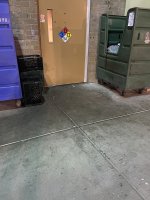
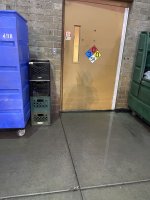
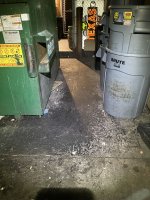
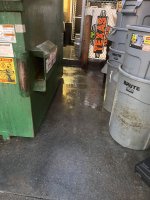
Here are a couple of before-and-after pairs from the F9 promo shots I was sent. This is concrete around dumpster and service-door areas, shot in dim light with the flash on. The "after" shots are wet from the wash.
Service door area, before:
Service door area, after:
Alley next to the dumpster, before:
Alley next to the dumpster, after:
You can also see the earlier before-and-after I posted here: Before & After: F9 Groundskeeper from Front 9 Restoration
How to apply it (per the datasheet)
1. Pre-clean oil first. If there are existing oil and hydrocarbon stains, clean those with F9 Double Eagle Degreaser first. Once you can see the stain beneath the pores of the concrete, apply Groundskeeper at the recommended dilution and surface clean. That gets the concrete set up for maintenance cleaning with Groundskeeper. Front 9's product page says standing, topical oil should be pre-cleaned with 5:1 F9 Double Eagle.
2. Mix it right. When mixing, always add the product into the water, not water into the product. Follow the recommended dilution ratios.
3. Pick your dilution.
4. Pre-wet and apply. Pre-wet the surface with water and spray it on. The product page says to wet the concrete so it's damp and not puddling.
5. Let it dwell. Dwell 2 to 10 minutes, then surface clean. Brushing may help on stubborn areas.
6. Water temperature. Per the product page, hot water is preferred and cold water is OK.
7. Coverage. The datasheet says coverage rates vary from 150' to 250' per gallon of diluted product.
Limitations to know about
Straight from the datasheet:
Safety: read this part
This is an industrial product, and Front 9 lists it for industrial use only. The safety data sheet shows it contains hydrochloric acid and is corrosive, so treat it that way.
Always read the full safety data sheet and datasheet from Front 9 before you use it.
Learn more
Get the full product details and the datasheet from Front 9 Restoration:
Thanks to Craig Harrison, President of Front 9 Restoration, for putting out a product built for the maintenance side of concrete cleaning.
– Ron Musgraves
Pressure Washing Institute / Power Wash Network
Tags: F9 Groundskeeper, Front 9 Restoration, Craig Harrison, concrete cleaning, concrete maintenance cleaner, low pH cleaner, pressure washing, power washing, commercial pressure washing, dumpster pad cleaning, how to clean concrete, Pressure Washing Institute, Power Wash Network
If you clean concrete for a living, you already know the first wash is only half the job. The part that makes money is keeping that concrete clean and coming back to maintain it. That's what F9 Groundskeeper is built for. It's Front 9 Restoration's industrial concrete maintenance cleaner, and I want to walk you through what it is, where it fits, how to apply it per the datasheet, and how to stay safe with it.
I've been talking about Groundskeeper with Craig Harrison, President of Front 9 Restoration, and you can see the product details at front9restoration.com.
What is F9 Groundskeeper?
Per the Front 9 datasheet, F9 Groundskeeper is a highly buffered, low pH hard surface maintenance cleaner. You use it after your initial degreasing, pre-cleaning, or just a hot water wash. It has wetting agents and surfactants to help cut through contaminants.
The datasheet lists these advantages:
- Surface stays cleaner longer vs. high pH products
- Quickly removes contaminates
- Reduces time spent on the job
- Biodegradable
- Phosphate free
Where to use it
Front 9 says Groundskeeper is ideal for:
- Soils
- Tire marks
- Entrances and exits
- High traffic areas
- Maintenance cleaning
What surfaces can you use it on?
Concrete, bricks, pavers, tile, most stone, grout, masonry, and other hard surfaces.
Photos from the F9 promo shots
Here are a couple of before-and-after pairs from the F9 promo shots I was sent. This is concrete around dumpster and service-door areas, shot in dim light with the flash on. The "after" shots are wet from the wash.
Service door area, before:
Service door area, after:
Alley next to the dumpster, before:
Alley next to the dumpster, after:
You can also see the earlier before-and-after I posted here: Before & After: F9 Groundskeeper from Front 9 Restoration
How to apply it (per the datasheet)
1. Pre-clean oil first. If there are existing oil and hydrocarbon stains, clean those with F9 Double Eagle Degreaser first. Once you can see the stain beneath the pores of the concrete, apply Groundskeeper at the recommended dilution and surface clean. That gets the concrete set up for maintenance cleaning with Groundskeeper. Front 9's product page says standing, topical oil should be pre-cleaned with 5:1 F9 Double Eagle.
2. Mix it right. When mixing, always add the product into the water, not water into the product. Follow the recommended dilution ratios.
3. Pick your dilution.
- Initial cleaning: 8:1 to 10:1. Use it more concentrated on heavily soiled areas and less concentrated on lightly soiled areas.
- Maintenance cleaning: 10:1 to 20:1, with the same rule: stronger for heavy soil, weaker for light soil.
- Downstream application is OK, but make sure the final dilution is 10:1 up to 20:1.
4. Pre-wet and apply. Pre-wet the surface with water and spray it on. The product page says to wet the concrete so it's damp and not puddling.
5. Let it dwell. Dwell 2 to 10 minutes, then surface clean. Brushing may help on stubborn areas.
6. Water temperature. Per the product page, hot water is preferred and cold water is OK.
7. Coverage. The datasheet says coverage rates vary from 150' to 250' per gallon of diluted product.
Limitations to know about
Straight from the datasheet:
- Use care and caution on stained or dyed surfaces that are unsealed.
- Strong dilutions may temporarily brown certain plant life.
- Use caution on polished surfaces.
- It may etch surfaces at strong dilutions.
- Avoid contact with unpainted aluminum and other metal surfaces.
- Dilute with water when using on glass.
Safety: read this part
This is an industrial product, and Front 9 lists it for industrial use only. The safety data sheet shows it contains hydrochloric acid and is corrosive, so treat it that way.
- Test first. Always perform a test to confirm compatibility and to determine the best dilution, application, and process for that substrate. Never use Groundskeeper undiluted, and never get undiluted product on porous surfaces.
- Wear your PPE. The datasheet says to wear goggles, protective gloves, and protective clothing when handling. It can cause permanent eye injury, so keep it out of your eyes, off your skin, and off your clothing.
- Ventilation. Avoid possible vapors and make sure you have adequate ventilation. An acid vapor respirator may be necessary in enclosed areas.
- Do not inhale or swallow it. Wash thoroughly after handling and keep the container closed.
- First aid, per the datasheet: for the skin, wash with water. For the eyes, flush with water for 15 minutes and see a physician immediately. If swallowed, drink large quantities of water and call a physician immediately.
- Keep it out of reach of children and do not freeze it.
Always read the full safety data sheet and datasheet from Front 9 before you use it.
Learn more
Get the full product details and the datasheet from Front 9 Restoration:
- Product page: https://front9restoration.com/f9-groundskeeper-industrial-concrete-maintenance-cleaner/
- Datasheet: https://front9restoration.com/wp-content/uploads/2022/04/F9-Groundskeeper-Technical-Data-Sheet.pdf
- Website: front9restoration.com
Thanks to Craig Harrison, President of Front 9 Restoration, for putting out a product built for the maintenance side of concrete cleaning.
– Ron Musgraves
Pressure Washing Institute / Power Wash Network
Tags: F9 Groundskeeper, Front 9 Restoration, Craig Harrison, concrete cleaning, concrete maintenance cleaner, low pH cleaner, pressure washing, power washing, commercial pressure washing, dumpster pad cleaning, how to clean concrete, Pressure Washing Institute, Power Wash Network