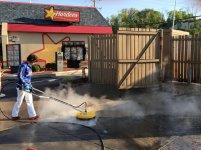
First off I would like to introduce myself. I am the guy in Ron's pictures pushing the broom. I did the demo for Ron, Jon, Kendra and Julio in Southern California. (Nice shoes huh!!) I have been in the commercial steam cleaning business for 16 years. In addition we have a products division (PCI Products Company) that sells Pave Clean for the entire Western U.S. as well as industrial absorbent products (
www.absorbentsonline.com) and consumer absorbents at (
www.cleanupstuff.com). "I thought I'd steak in a little advertising." Let me try to answer some of the concerns here about Pave Clean.
I got involved with Pave Clean because of one reason - environmental regulations. Five years ago I gave up parking structure cleaning (we had 4 to 6 steam cleaning units working most weekends) because I did not want to risk my company to hugh EPA fines and I did not want to invest thousands of dollars in reclamation systems, deal with the equipment headaches and add the additional labor (more headaches) to my payroll which is required if you are doing "zero discharge" work.
My first impression of Pave Clean was similar to most. It only covers up. It took me several months of working with it before I realized it works and the temendous potential there is with a "dry" cleaning process to clean up oil. At present we do thousands of parking stalls on a quarterly bases with Pave Clean.
There is a contracter in some other states who do hundreds of drive up locations each month.
Pave Clean absorbs oil-period. It is real fine like flour so it has more surface to absorb the oil and to get into the pours of the concrete. It can be colored to somewhat match the concrete. With several applications it will draw the oil from the substrate and form a barrior for cleaning up new oil drips. It also covers up the carbon stains. No it will not remove all of the carbon stains completely and neither will pressure washing.
If you look at Jon's pictures in his thread the before picture (#1) side by side with the 5 day later picture (#3) you will see that the wet oil spots above the crack are gone in #3 and the ones you see are on #3 are new drips (they are in a different location). It would be interesting if Jon would now take a photo of the same area before and then pressure wash it using his best chemicals, rotary nozzel, spinner, etc. Then take an after picture and also a 5 day later picture. To do this legally in California Jon would have to hook up, plug the drain on the drive, do the job, collect the water, repack his equipment, dispose of the water and provide the customer with proof he disposed of it legally. I believe the stains will still there, prove me wrong. (Jon I am not picking on you because based upon your comments you see the value of the product but it would be an interesting test for comparison).
To rap this up here are answers to a few questions on this and another board.
DISPOSAL - Dispose of in compliance with local, state and federal regulations. We don't recommend because they vary from location to location. I will tell you there is very little to dispose of. We combine it in 55 gal drums and have it pickup by companies that pick up other absorbent waste from plants. Disposal costs are insignificant.
COVERAGE- Coverage varies based upon amount oil you are cleaning up. You will use more product the first time but less and less each additional cleaning of the area. We used about one eight of pound for the demo (thats what you see being broomed on Ron's photo. On a thousand parking stalls you will use about 500 pounds on the initial cleaning. If doing on a quarterly bases you will use less the half that amount. For monthly drive-ups of a couple of cleanings you will use about 20 pounds per thirty locations with two lanes per location and center stripping them. Note that these are approximate amounts.
WHY DON'T THE DEMO LOOK LIKE THE PHOTOS ON THE DELCO AND PAVE CLEAN SITE? Because I wanted to show how the product attaches to the oil (the solid white spots are that way because that is where the oil is) Remember that this is a product for cleaning up oil. By using more product and doing the entire lane I could make it look like the other photos.
BLEED THROUGH. On initial cleanings you will get bleed through of oil because it is pulling oil from the substrate of the concrete. When we quote cleaning of parking structures, included in the cost is we come back in 7 to 14 days and reapply on stalls that bleed back. You have to let the product work. On real bad locations that haven't been cleaned in years you will continue to get bleed back. If you steam clean a stall or drive up lane and come back the next day you have oil that rises to the top and is wet (and can be slick). With Pave Clean it is not slick. You have to bid with this product just like steam cleaning, you charge more for bigger messes because you need to use more product and time.
Ron, Jon and Kendra answered alot of questions and I thank them for taking the time to see the demo. Please feel free to contact us if there are any other questions. We will also be looking at the board.






 I think I was handing her my camera at that moment!